Indications, posology and method of administration
THERAPEUTIC INDICATIONS
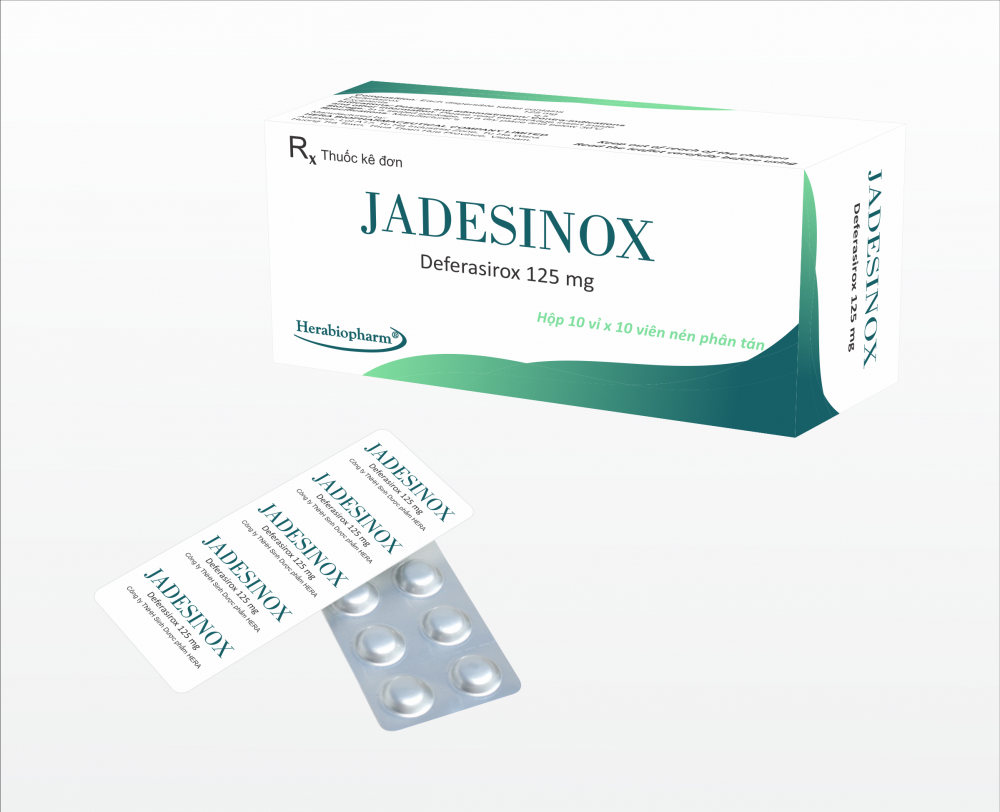
- Deferasirox is indicated for the treatment of chronic iron overload due to frequent blood transfusions (≥ 7 ml/kg/month of packed red blood cells) in patients with beta thalassaemia major aged 6 years and older.
- Deferasirox is also indicated for the treatment of chronic iron overload due to blood transfusions when deferoxamine therapy is contraindicated or inadequate in the following patient groups:
+ In paediatric patients with beta thalassaemia major with iron overload due to frequent blood transfusions (≥ 7 ml/kg/month of packed red blood cells) aged 2 to 5 years.
+ In adult and paediatric patients with beta thalassaemia major with iron overload due to infrequent blood transfusions (< 7 ml/kg/month of packed red blood cells) aged 2 years and older.
+ In adult and paediatric patients with other anaemias aged 2 years and older.
- Deferasirox is also indicated for the treatment of chronic iron overload requiring chelation therapy when deferoxamine therapy is contraindicated or inadequate in patients with non-transfusion-dependent thalassaemia syndromes aged 10 years and older.
POSOLOGY AND METHOD OF ADMINISTRATION
Treatment with deferasirox should be initiated and maintained by physicians experienced in the treatment of chronic iron overload.
Posology:
Transfusional iron overload:
It is recommended that treatment be started after the transfusion of approximately 20 units (about 100 ml/kg) of packed red blood cells (PRBC) or when there is evidence from clinical monitoring that chronic iron overload is present (e.g. serum ferritin > 1,000 µg/l). Doses (in mg/kg) must be calculated and rounded to the nearest whole tablet size. If lower strengths of the product are not marketed and are required for administration of optimal doses of deferasirox, other medicinal products containing deferasirox may be more suitable to obtain the correct posology and should be used.
The goals of iron chelation therapy are to remove the amount of iron administered in transfusions and, as required, to reduce the existing iron burden.
In case of switching from film-coated tablets to dispersible tablets, the dose of dispersible tablets should be 40% higher than the dose of film-coated tablets, rounded to the nearest whole tablet.
Starting dose
The recommended initial daily dose of deferasirox dispersible tablets is 20 mg/kg body weight.
An initial daily dose of 30 mg/kg may be considered for patients who require reduction of elevated body iron levels and who are also receiving more than 14 ml/kg/month of packed red blood cells (approximately > 4 units/month for an adult).
An initial daily dose of 10 mg/kg may be considered for patients who do not require reduction of body iron levels and who are also receiving less than 7 ml/kg/month of packed red blood cells (approximately < 2 units/month for an adult). The patient’s response must be monitored and a dose increase should be considered if sufficient efficacy is not obtained.
For patients already well managed on treatment with deferoxamine, a starting dose of deferasirox dispersible tablets that is numerically half that of the deferoxamine dose could be considered (e.g. a patient receiving 40 mg/kg/day of deferoxamine for 5 days per week (or equivalent) could be transferred to a starting daily dose of 20 mg/kg/day of deferasirox dispersible tablets). When this results in a daily dose less than 20 mg/kg body weight, the patient’s response must be monitored and a dose increase should be considered if sufficient efficacy is not obtained.
Dose adjustment
It is recommended that serum ferritin be monitored every month and that the dose of deferasirox be adjusted, if necessary, every 3 to 6 months based on the trends in serum ferritin. Dose adjustments may be made in steps of 5 to 10 mg/kg and are to be tailored to the individual patient’s response and therapeutic goals (maintenance or reduction of iron burden). In patients not adequately controlled with doses of 30 mg/kg (e.g. serum ferritin levels persistently above 2,500 μg/l and not showing a decreasing trend over time), doses of up to 40 mg/kg may be considered. The availability of long-term efficacy and safety data with deferasirox dispersible tablets used at doses above 30 mg/kg is currently limited (264 patients followed for an average of 1 year after dose escalation). If only very poor haemosiderosis control is achieved at doses up to 30 mg/kg, a further increase (to a maximum of 40 mg/kg) may not achieve satisfactory control, and alternative treatment options may be considered. If no satisfactory control is achieved at doses above 30 mg/kg, treatment at such doses should not be maintained and alternative treatment options should be considered whenever possible. Doses above 40 mg/kg are not recommended because there is only limited experience with doses above this level.
In patients treated with doses greater than 30 mg/kg, dose reductions in steps of 5 to 10 mg/kg should be considered when control has been achieved (e.g. serum ferritin levels persistently below 2,500 μg/l and showing a decreasing trend over time). In patients whose serum ferritin level has reached the target (usually between 500 and 1,000 μg/l), dose reductions in steps of 5 to 10 mg/kg should be considered to maintain serum ferritin levels within the target range. If serum ferritin falls consistently below 500 μg/l, an interruption of treatment should be considered.
Non-transfusion-dependent thalassaemia syndromes:
Chelation therapy should only be initiated when there is evidence of iron overload (liver iron concentration [LIC] ≥ 5 mg Fe/g dry weight [dw] or serum ferritin consistently > 800 μg/l). LIC is the preferred method of iron overload determination and should be used wherever available. Caution should be taken during chelation therapy to minimise the risk of over-chelation in all patients. In case of switching from film-coated tablets to dispersible tablets, the dose of dispersible tablets should be 40% higher than the dose of film-coated tablets, rounded to the nearest whole tablet.
Starting dose
The recommended initial daily dose of deferasirox dispersible tablets in patients with non-transfusion-dependent thalassaemia syndromes is 10 mg/kg body weight.
Dose adjustment
It is recommended that serum ferritin be monitored every month. After every 3 to 6 months of treatment, a dose increase in increments of 5 to 10 mg/kg should be considered if the patient’s LIC is ≥ 7 mg Fe/g dw, or if serum ferritin is consistently > 2,000 μg/l and not showing a downward trend, and the patient is tolerating the medicinal product well. Doses above 20 mg/kg are not recommended because there is no experience with doses above this level in patients with non-transfusion-dependent thalassaemia syndromes.
In patients in whom LIC was not assessed and serum ferritin is ≤ 2,000 μg/l, dosing should not exceed 10 mg/kg.
For patients in whom the dose was increased to > 10 mg/kg, dose reduction to 10 mg/kg or less is recommended when LIC is < 7 mg Fe/g dw or serum ferritin is ≤ 2,000 μg/l.
Treatment cessation
Once a satisfactory body iron level has been achieved (LIC < 3 mg Fe/g dw or serum ferritin < 300 μg/l), treatment should be stopped. There are no data available on the retreatment of patients who reaccumulate iron after having achieved a satisfactory body iron level and therefore retreatment cannot be recommended.
Special populations
Elderly patients (≥ 65 years of age):
The dosing recommendations for elderly patients are the same as described above. In clinical trials, elderly patients experienced a higher frequency of adverse reactions than younger patients (in particular, diarrhoea) and should be monitored closely for adverse reactions that may require a dose adjustment.
Paediatric population:
Transfusional iron overload:
The dosing recommendations for paediatric patients aged 2 to 17 years with transfusional iron overload are the same as for adult patients. Changes in weight of paediatric patients over time must be taken into account when calculating the dose.
In children with transfusional iron overload aged between 2 and 5 years, exposure is lower than in adults. This age group may therefore require higher doses than are necessary in adults. However, the initial dose should be the same as in adults, followed by individual titration.
Non-transfusion-dependent thalassaemia syndromes:
In paediatric patients with non-transfusion-dependent thalassaemia syndromes, dosing should not exceed 10 mg/kg. In these patients, closer monitoring of LIC and serum ferritin is essential to avoid overchelation: in addition to monthly serum ferritin assessments, LIC should be monitored every three months when serum ferritin is ≤ 800 μg/l.
Children from birth to 23 months:
The safety and efficacy of deferasirox in children from birth to 23 months ofage have not been established. No data are available.
Patients with renal impairment:
Deferasirox has not been studied in patients with renal impairment and is contraindicated in patients with estimated creatinine clearance < 60 ml/min.
Patients with hepatic impairment:
Deferasirox is not recommended in patients with severe hepatic impairment (Child-Pugh Class C). In patients with moderate hepatic impairment (Child-Pugh Class B), the dose should be considerably reduced followed by progressive increase up to a limit of 50%, and deferasirox must be used with caution in such patients. Hepatic function in all patients should be monitored before treatment, every 2 weeks during the first month and then every month.
Method of administration: For oral use
Deferasirox must be taken once daily on an empty stomach at least 30 minutes before food, preferably at the same time each day.
The dispersible tablets are dispersed by stirring in a glass of water or orange or apple juice (100 to 200 ml) until a fine suspension is obtained. After the suspension has been swallowed, any residue must be resuspended in a small volume of water or juice and swallowed. The tablets must not be chewed or swallowed whole.
CONTRAINDICATIONS
- Hypersensitivity to the active substance or to any of the excipients.
- Combination with other iron chelator therapies as the safety of such combinations has not been established.
- Patients with estimated creatinine clearance <60 ml/min.






 © 2016 Hera Biopharm. All Rights Reserved. Designed By Herabiopharm
11.png)






.jpg)
.jpg)
.jpg)
.jpg)